SaaS Product Development: From Idea to Launch
SaaS Development
Custom Software Development
Digital Transformation

Shaik Moosa
November 09, 2026 | 4 min
Share to
Building a SaaS product requires more than developing software. Startups and businesses must validate their ideas, understand customer requirements, design user-friendly applications, select suitable technologies, and establish reliable infrastructure.
SaaS product development involves planning, designing, building, testing, and launching cloud-based applications that users can access through the internet.
For startup founders, entrepreneurs, and businesses planning to introduce subscription-based software, a structured development approach helps reduce unnecessary investment and technical risks.
This guide explains the SaaS product development process, essential features, technology considerations, development costs, and practical steps for launching a SaaS application.
1. What Is SaaS Product Development?
SaaS product development is the process of creating cloud-hosted software applications that customers access through web browsers or supported mobile applications.
Unlike traditional software installed on individual computers, SaaS applications are generally hosted and maintained by the software provider.
Common examples include:
Customer Relationship Management (CRM) platforms. Enterprise Resource Planning (ERP) applications. Project and task management software. Human resource management systems. Accounting and invoicing applications. Business analytics and reporting platforms.
SaaS products commonly use subscription-based pricing, although usage-based and other commercial models are also possible.
The objective is not simply to build an application. It is to develop a reliable software product that solves customer problems and can be maintained, improved, and delivered continuously.
2. Why Are Businesses Investing in SaaS Products?
SaaS applications offer businesses opportunities to deliver digital services, automate workflows, and reach customers without distributing traditional software installations.
However, building a sustainable SaaS business requires more than offering cloud-based access.
Several factors influence its value.
Recurring revenue: Subscription models can provide more predictable revenue when customer retention remains healthy.
Centralized updates: Providers can release improvements and security updates without requiring customers to install each new version.
Scalability: Cloud infrastructure can support changing usage requirements when applications are designed and operated appropriately.
Customer accessibility: Users can access software through supported devices and internet connections.
Integration capabilities: APIs can connect SaaS applications with payment systems, communication tools, and existing business platforms.
Product improvement: Usage analytics and customer feedback can help teams identify problems and prioritize new capabilities.
These benefits depend on product quality, customer demand, infrastructure costs, and ongoing operational management.
3. Essential Features of a SaaS Application
Not every SaaS product requires the same functionality. However, several foundational capabilities are commonly needed.
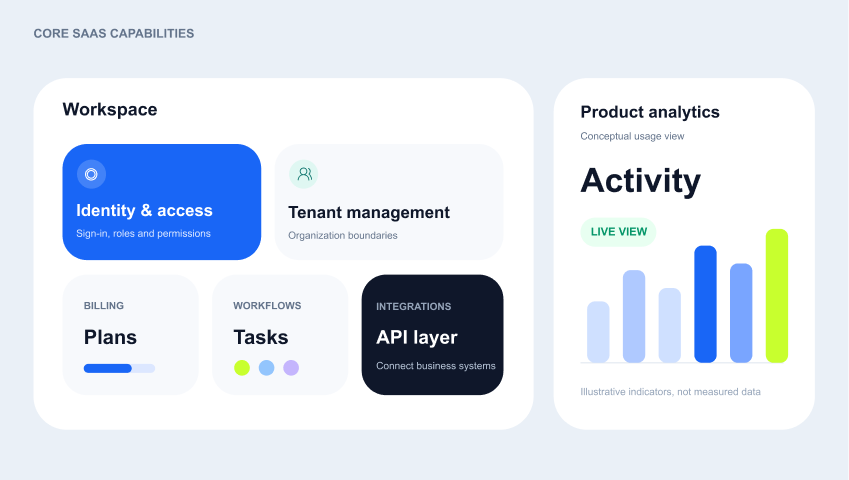
| Feature | Why It Matters |
|---|---|
| User authentication | Secures user access |
| Role-based access control | Defines permissions for different users. |
| Tenant management | Supports multiple customer organizations. |
| Subscription management | Handles plans and billing. |
| Application dashboard | Provides access to important information. |
| API integrations | Connects external business systems. |
| Data management | Organizes and protects application information. |
| Notifications | Communicates important events. |
| Analytics and reporting | Helps users understand activities and outcomes. |
| Administration | Supports account and platform management. |
User authentication and access control
Authentication verifies user identities, while authorization determines which information and actions each user can access.
Businesses should evaluate secure login methods, permission management, session handling, and account-recovery requirements.
Multi-Tenant Architecture
Multi-tenancy allows a SaaS application to serve multiple customer organizations using shared application infrastructure.
A well-designed multi-tenant system must enforce appropriate separation between customer data and permissions.
Not every SaaS product requires the same tenancy model. The architecture should reflect security, operational, and customer requirements.
Subscription and Billing Management
Subscription-based applications may require:
Pricing plans. Free trials. Subscription upgrades and downgrades. Payment processing. Invoice generation. Renewal and cancellation workflows.
Billing functionality should be designed around the selected commercial model and supported payment providers.
4. SaaS Product Development Process: From Idea to Launch
A structured development process helps businesses move from an initial idea to a usable application.
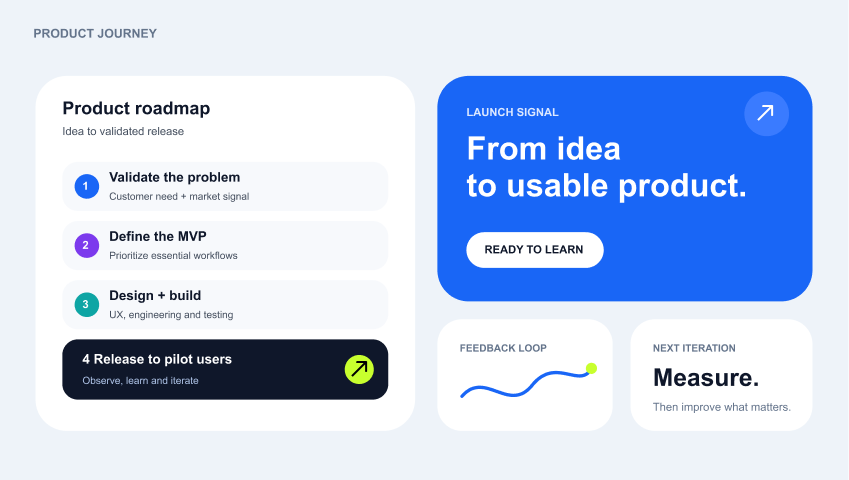
Step 1: Validate the Product Idea
Identify the customer problem the software will solve.
Conduct customer interviews, review existing workflows, and evaluate whether potential users are willing to adopt or pay for the proposed solution.
Step 2: Define Product Requirements
Document the target users, business objectives, essential features, workflows, integrations, and security requirements.
Separate must-have functionality from features that can be introduced later.
Step 3: Build a Minimum Viable Product
A Minimum Viable Product (MVP) contains the essential functionality needed to deliver customer value and test important assumptions.
For example, an MVP for a project management SaaS application might include task creation, assignment, status tracking, and team collaboration.
Advanced automation and reporting can be evaluated after initial customer feedback.
Step 4: Design the user experience
Create user flows, wireframes, interface designs, and interactive prototypes.
Validate whether users can complete important tasks without unnecessary complexity.
Step 5: Develop the application
Implement the frontend, backend, database, authentication, business workflows, and required integrations.
Choose an architecture that supports current requirements without introducing unnecessary complexity.
Step 6: Test the product
Perform functional, integration, usability, security, and performance testing.
For multi-tenant applications, verify that users cannot access another organization's protected information.
Step 7: Deploy and launch
Configure production infrastructure, monitoring, backups, domains, security controls, and support processes.
Consider launching with a limited group of customers before expanding availability.
Step 8: Monitor and improve
Track product usage, customer feedback, reliability, and subscription performance.
Use these insights to improve existing workflows and prioritize future development.
5. How to Choose the Right SaaS Technology Stack
Technology decisions influence application maintainability, performance, security, and development complexity.
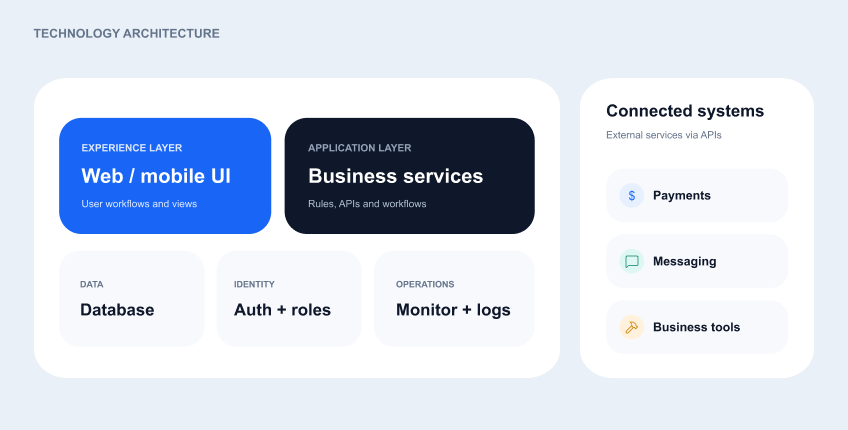
There is no single technology stack suitable for every SaaS product.
| Technology Area | Common Options |
|---|---|
| Frontend development | React, Next.js, Angular |
| Backend development | Node.js, Python, Java |
| Database | PostgreSQL, MySQL |
| Cloud hosting | AWS, Microsoft Azure, Google Cloud |
| Authentication | OAuth 2.0, OpenID Connect |
| API architecture | REST, GraphQL |
| Containerization | Docker |
| Monitoring | Application logs, metrics, and alerts |
When evaluating technologies, consider:
Development requirements: What functionality must the application support?
Team expertise: Can the development team maintain the selected technologies?
Integration requirements: Which external services and business systems must connect?
Security: What authentication, authorization, encryption, and data protection measures are required?
Scalability: How might the application's usage and infrastructure requirements change?
Maintenance: What resources will be required to update and operate the product?
Startups should avoid selecting complex architectures solely because they are popular.
A maintainable application architecture is often more valuable than unnecessary technical complexity.
6. How Much Does SaaS Product Development Cost?
SaaS development costs vary according to product scope, complexity, design requirements, integrations, and infrastructure.
A simple workflow application may require significantly less development effort than a platform supporting complex business processes and multiple customer organizations.
Common cost factors include:
Product discovery and requirement analysis. UI/UX research and interface design. Frontend and backend development. Database and application architecture. Third-party integrations. Subscription and payment functionality. Security and quality assurance. Cloud infrastructure. Deployment and ongoing maintenance.
Businesses should also consider operational costs after launch, including hosting, monitoring, support, and software updates.
A detailed development proposal should identify the project scope, assumptions, deliverables, and recurring expenses.
The lowest initial development estimate does not necessarily represent the lowest long-term cost.
7. Practical Example: Building a SaaS CRM for Small Businesses
Consider a hypothetical startup planning to develop a CRM platform for small sales teams.
The startup identifies that many prospective customers manage leads using spreadsheets, emails, and messaging applications.
These disconnected workflows make it difficult to track follow-ups and monitor sales opportunities.
A structured SaaS development approach could follow these steps.
Step 1: Validate the problem
Interview sales teams to understand their current processes, difficulties, and willingness to adopt a new CRM.
Step 2: Define the MVP
Prioritize contact management, lead tracking, sales pipelines, user access, and basic reporting.
Step 3: Design the workflows
Create interfaces for adding leads, assigning responsibilities, updating opportunities, and reviewing activities.
Step 4: Develop and test
Build the application, implement appropriate security controls, and test important user workflows.
Step 5: Launch a pilot
Introduce the product to a small group of customers and collect feedback.
Step 6: Improve the product
Evaluate requested features such as email integration, workflow automation, and advanced analytics.
The potential benefit is a more organized sales process and better visibility into customer activities.
Actual adoption, efficiency improvements, and commercial performance should be measured rather than assumed.
8. How to Prepare a SaaS Product for Launch
Launching a SaaS application requires technical readiness and operational planning.
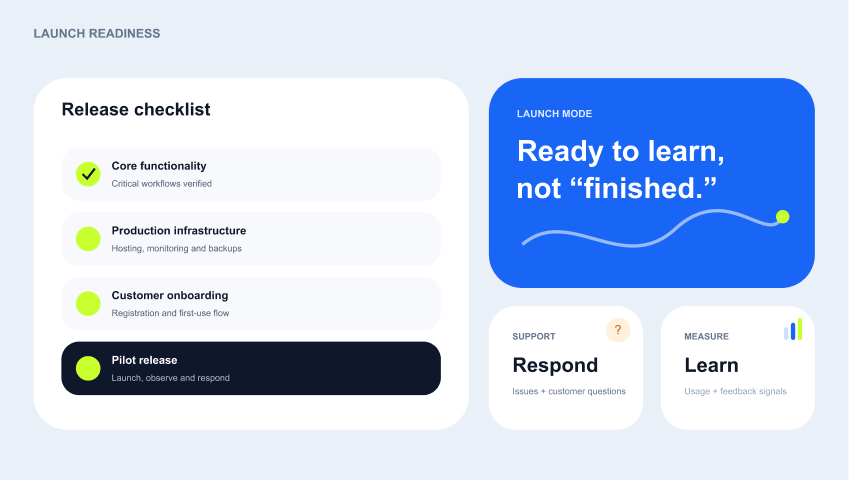
Phase 1: Validate Core Functionality
Confirm that essential workflows, authentication, permissions, and subscription processes work correctly.
Phase 2: Prepare Infrastructure
Configure hosting, application monitoring, backups, security controls, and recovery procedures.
Phase 3: Test Customer Onboarding
Verify that new users can register, configure accounts, understand the interface, and complete their first important task.
Phase 4: Launch With Early Customers
Begin with a controlled release where practical.
Monitor technical issues, customer feedback, and product usage.
Phase 5: Measure Product Performance
Track relevant metrics such as:
User activation. Customer retention. Trial-to-paid conversion. Monthly recurring revenue. Customer churn. Application availability.
Use the findings to guide product improvements and future releases.
9. Common SaaS Development Mistakes to Avoid
Building too many features: Prioritize the core problem before developing advanced functionality.
Skipping market validation: Confirm customer demand before committing significant resources.
Ignoring user experience: Test important workflows with representative users.
Overengineering infrastructure: Select architecture based on actual requirements and reasonable growth expectations.
Neglecting security: Include authentication, access control, data protection, and recovery planning throughout development.
Underestimating maintenance: Plan for infrastructure costs, technical support, updates, and operational monitoring.
Launching without measurable goals: Define adoption and product success metrics before release.
Successful SaaS development requires both a reliable technical foundation and continuous attention to customer needs.
10. How ApptDev Supports SaaS Product Development
ApptDev IT Services focuses on helping businesses translate software requirements into digital applications and technology solutions.
Its development approach can support organizations exploring custom business software, SaaS applications, and digital product initiatives.
Relevant areas include:
Product Development: Translating business requirements into application features and workflows.
UI/UX Design: Creating interfaces that support usability and business processes.
Custom Application Development: Building applications around specific organizational requirements.
Business Process Automation: Digitizing workflows and reducing dependence on disconnected manual processes.
System Integration: Connecting applications and business systems through appropriate integration methods.
For startups and businesses planning SaaS products, defining the scope, validating essential functionality, and establishing a practical development roadmap are important early steps.
Specific project capabilities, technologies, delivery arrangements, and ongoing support should be confirmed during project discussions.
Conclusion
SaaS product development requires a combination of customer research, product planning, UI/UX design, software engineering, testing, and operational management.
Businesses should begin by validating the problem, defining essential features, and selecting technologies that match their actual requirements. A focused MVP can help teams collect feedback before investing in a larger product.
Successful SaaS development does not end at launch. Continuous improvement, customer retention, security, and reliable operations are essential for building a sustainable software business
FAQs
Related Blogs
Can you really build an app with no-code?
In a world where digital transformation is no longer optional, the ability to create custom applications quickly has become a competitive advantage.
Read More
How to create an AI app without coding?
In today's rapidly evolving technological landscape, artificial intelligence has transformed from an exclusive domain of specialized developers to an accessible tool for businesses and individuals alike.
Read More
How to Build a Simple App to Track Your Inventory—No Coding Needed
Here’s a concise guide to building a custom inventory-tracking app on ApptDev—no coding required. You’ll learn why inventory management matters, how ApptDev’s visual tools streamline every step, and key insights to maximize efficiency. By following our six-step walkthrough, you’ll go from blank canvas to deployed app in under an hour, complete with automated reorder alerts and mobile-ready interfaces.
Read More